Part 3: Kidding Issues
This series is not meant to be comprehensive, but I hope that it’s helpful, especially to those having pregnant does with no experience. I wish I had had such a webpage series when I was where you are now!
Part 1 covered preparations for kidding, including prenatal care of does.
Part 2 focused in on the basic steps and signs of normal labors and deliveries, which a vast majority of deliveries are.
In this last post, we will focus on delivering kids who present more difficult positions (called dystocia), and gives a few ideas of how to help distressed kids after they are born. The time to think about dystocic positions is now, before it happens, so that you can at least know what you might encounter and the basic gist of how to solve problems that may be presented!
First: As I suggested in Part 1, watching YouTube videos of normal births is a very good preparation.
Second: I hope you have a mentor who will be there for you (by phone or in person) if you need her. Online groups are not a good substitute here. Try to develop a relationship with an experienced goat momma before you need her!
Third: Ditto for a vet. God forbid that you’ll need one, but it’s important that you have a relationship with one before you need his or her services. Find out what your vet considers a relationship: registration, perhaps, or a well check before delivery? It may be money well spent to make sure that the vet will be there for you should you need him or her.
Fourth: Make sure that your nails are closely clipped as kidding approaches. Have hot, soapy water ready when pushing starts, and have gloves and KY jelly nearby. You’ll also need to give a shot of LA 200 antibiotic after kidding if you have had to reach inside a doe.
On to some self help strategies
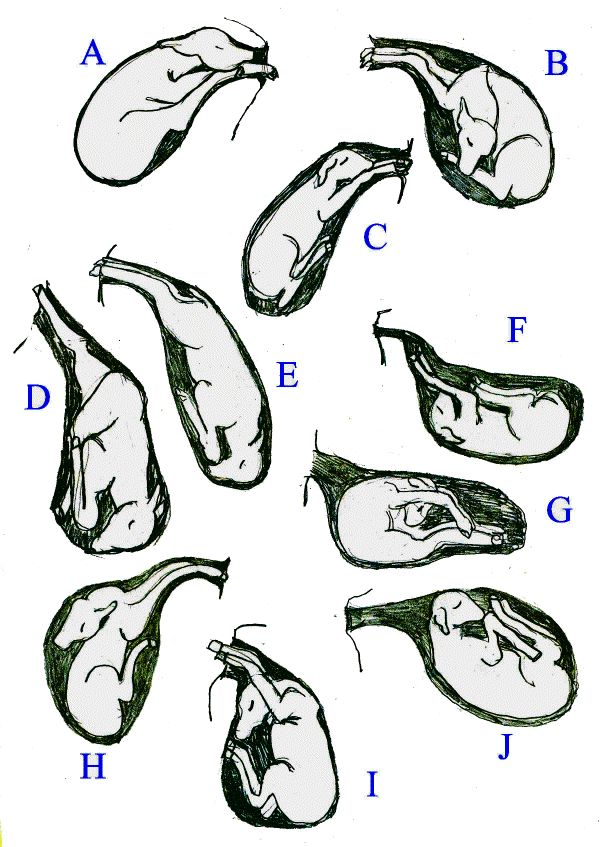
Study diagrams of both ideal and dystotia positions. (The link here is extremely helpful, with a free PDF that you can print, laminate, and keep in your kidding box for reference.) Print out these diagrams and think hard about why the kids can’t be born in certain positions without adjustments.
Credit for the diagram on the left to thegoatchick.com. Click on the link to see positions explained.
If you have to reposition a kid inside a mother, you will need to have the kid’s anatomy well fixed in your mind because you’ll be working by feel only! Try these exercises before your first doe kids:
- Study your adult goat’s body carefully, looking for features that you’ve seen in diagrams. Picture her internal anatomy.
- Now, closing your eyes, run your hands over your adult goat’s body, slowly. (Maybe while she’s eating.)
- Start with the front end. Put your hand on her head. Move your hand down her jaw to her neck, and then to her shoulder. Make your way down the front right leg, noting the ways that the various joints bend.
- Feel the point of the elbow at the back of the front leg, and then the foreleg. The elbow bends the knee towards the chest and mouth.
- Find the knee and bend it; it bends the lower leg away from the chest, towards the belly.
- Find the fetlock and bend it; it bends the hoof towards the belly.
- Find the pastern and the hoof.
- Pick up the front leg and stretch it out in front and back under the belly.
- Do the same with the hind end and legs. The hock bends the lower hind leg towards the body, as does the front knee.
- Start with the front end. Put your hand on her head. Move your hand down her jaw to her neck, and then to her shoulder. Make your way down the front right leg, noting the ways that the various joints bend.
- Now, using the diagrams that you have of kids that are not in good positions imagine how you would reach inside a goat to find the initial dystocia and then correct it by moving limbs.
- In doing this over the years, I have found that I need first to become sure of one body part. Then I can usually work from it to figure out what I’ve got and how to deal with it.
The biggest challenges are these: to make sure that you’re feeling all one kid (and not parts of multiples, if they’re tangled) and to work carefully, if quickly, because in breach situations, the umbilical cord separates once the kid enters the birth canal and he can run out of air and suffocate.
Study this picture: which way to limb joints bend. Where are the ears located on the head? How does the ear feel different from the tail? How does the back of the skull feel different from the nose?
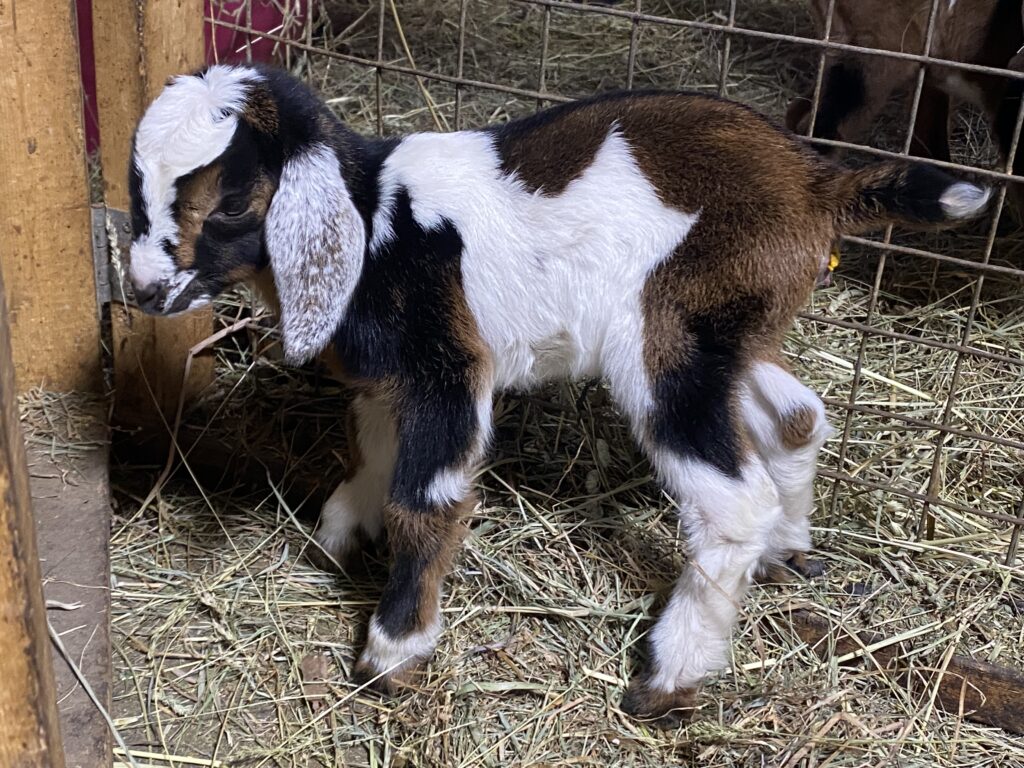
Difficult Kid Presentations
As we discussed in Part 2, there are two ideal, or normal, kid presentations:
- Front hooves and nose together, in a diving position, with legs stretched out behind
- Back legs first, stretched out, and then the body, head, and forefeet.
- Typically as well, each kid is lined up, one at a time, so that they can travel through the birth canal easily and slip out of the doe’s body, typically with only a handful of good, hard pushes.
- Some older does can also push out small breached (butt first) kids, or kids with only one foreleg back unaided. First fresheners will typically have trouble with these positions, however, especially if it’s a singleton kid.
Generally speaking, one never goes inside the doe until she has worked hard at pushing (see time allotments below). The cervix must fully dilate (open) for the kids to pass through. In the normal course of events, early labor contractions line the well positioned kids up one at a time while opening the cervix. When the first kid has moved up and put pressure on the dilated cervix, the doe has the urge to push. She bears down on the well positioned kid, and it moves rapidly through the birth canal and is born. She may stand to do this, but most of mine lay down. It is important to not rush this process by going in before the cervix is fully dilated. That’s why we wait a good 30 minutes (time it!) from the first push if there has been no water bag rupture before exploring within the goat.
Each kid is encased in his own amniotic bag of waters. Kids can be born without rupturing these sacks, but most often they break either just before birth, or during it. The membrane that surrounds them is thin, flexible, wet, and translucent. It protects the kid from infection and helps to keep multiple kids apart while in the womb, protecting the all-important connections between umbilical cords and placenta(s). There are other birth fluids in the uterine cavity as well. This moist environment helps the kids to slide around and adds pressure to the cervix so the pushing impulse occurs.
Each kid has an umbilical cord that is connected to a placenta, which is supplying oxygen to the kid. During a normal delivery, the cord typically severs itself as the kids is pushed out of the doe’s body. The kid will amost immediately take a breath in response, and this is why we seek to wipe off their mouths and noses ASAP. It’s also where the challenge with distotya kids is significant. When either repositioning kids, or untangling them, or hauling them out hind end first, be prepared to move quickly so that they don’t gulp amniotic fluid, and aspirate it or, worst case, drown before you get them out.
When do we suspect that there might be issues with kid presentation and need to go inside the doe?
- If the doe has been pushing hard for over 30 minutes and no kids have come, but no bag of waters has ruptured.
- In this case, one suspects that either a kid is stuck in an awkward position in the canal, or kids are tangled, or that there is a singleton who is too big for the doe to push out unaided. Or a kid may be dead.
- The preferable problem is the malpositioned kid. One can reach inside the doe and move body parts around to make birth possible fairly quickly and relatively easily. Often only one kid of multiples is dystocic.
- If the bag of waters has broken and she has been pushing hard for only 15 minutes and no kid is presenting, or a kid is presenting no hooves, but an ear or a tail and his sack is ruptured.
- This is a “stuck kid” that must be repositioned before it can pass through the birth canal. His head is turned, or he is breach.
- It is important to go in sooner if the bag of waters has broken, because the birth process depends on things being slippery. If the birth canal and kid dry out, things cannot slide properly, and internal damage can be done.
- This is a “stuck kid” that must be repositioned before it can pass through the birth canal. His head is turned, or he is breach.
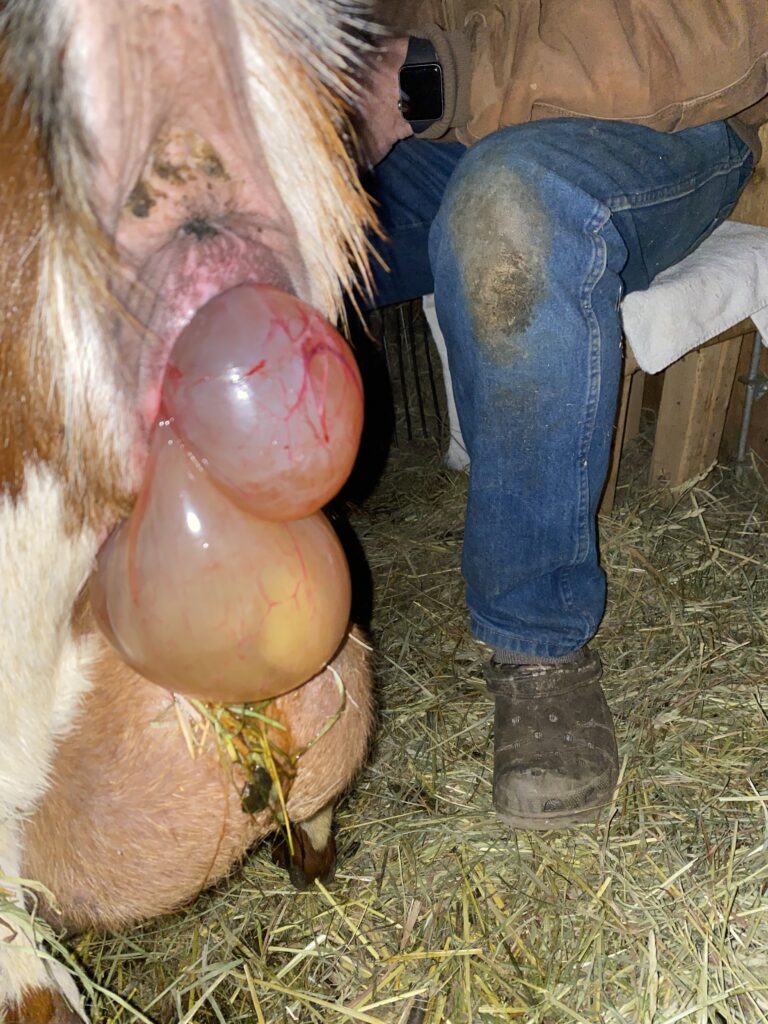
When, as in the picture here, there are more than one amniotic sack presenting (such that two kids are trying to come at the same time).
In this case, one must be pushed back into the birth canal, while the other is quickly eased out. It is necessary to go in carefully and find the one more close to birth (bottom one, here) and then GENTLY and slowly push the other back into the uterus. Once the first is born, try to get the second one out pronto.
The same concerns about air supply due to severed umbilical cords apply, so one has to work rather quickly.
What to do?
- FIGHT to stay calm and get focused. Do what you have to to calm yourself. Pray. Breathe. Drink a bit of water (it’s probably been a long day) and tell yourself that you can only do your best. It truly is all in God’s hands, and not in human control.
- Wash your hands really well in hot, soapy water.
- Don gloves (or don’t), and get your hands slippery with KY jelly or olive oil (which has natural antibacterial properties).
- Gently reach inside and start to feel for a part of the kid that you can recognize. I close my eyes so I can concentrate on what I’m feeling. Once you have a mouth, or a hoof, or a tail, follow the body to figure out what’s amiss.
- Work with the doe’s contractions: wait to move limbs, or push a kid back if needed, then work with her contraction to pull a kid out.
- You can pull hard when you get to pulling. Baby kids are much tougher than we think. But be gentle with the doe: protect her uterus from tears by shielding it from sharp little hooves with your hand as you reposition limbs, etc.
Singletons
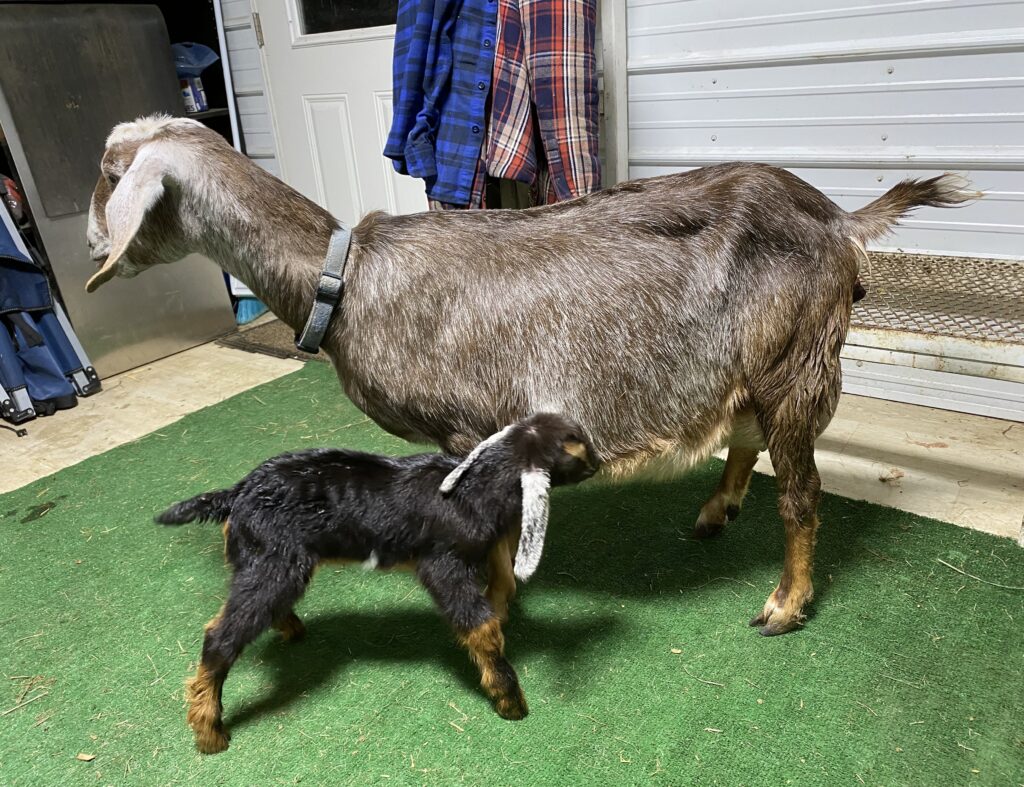
With first fresheners particularly, but really with all deliveries, one concern is with singleton kids, especially males because they are usually larger in general than female kids. A single kid can grow large because it gets all the prenatal nutrition to itself. Consequently, it can be difficult to deliver because the head is large for the birth canal, and doubly so if it’s malpositioned.
This doe was 10 days late with this singleton boy stuck, breached, inside. Look how big he was at birth!
In a first freshener, this kid is the first to open the birth canal, and things can be tighter and less elastic than with older does who have had a litter or two. Pulling is hard on the vulva, and it can look really bad when you get done. There will always be blood, and it’s hard to know how much blood is too much.
Does can go into shock. If she gets shocky, put cayenne pepper mixed with honey on her tongue every 20 minutes and keep her warm with a blanket. If she will, have her drink the warm tea that has molasses in it. It will give her energy and hydrate her.
Births can be quiet or a surprise, noisy or peaceful, chaotic and terrifying, or sweet.
In the end, births are always a miracle, and we should thank God that we get to participate in this process. We at Storybook Farm regularly pray for our does. We pray for their safety and good health through pregnancy and delivery. I always pray for twins, since they’re typically easiest on does. We pray for ourselves when perplexed or when we have to go in and rearrange babies. God is there; He cares, and He is good. Births don’t always go as we could wish, but He is there in those moments to comfort us and to remind us that we, too, are creatures.
Be of good cheer! You can only do your best at the end of the day. Pray that it’s good enough, and then trust your faithful Creator with the rest. May your kidding season be blessed!
In case you found this part first, it is the third in a series. Here are the links to Part 1 and Part 2.